US AI drug discovery trends 94.7% connectivity ensures flow
"The intersection of computational power and biological understanding is redefining how we approach therapeutic discovery."
The US AI drug discovery trends focus on integrating massive datasets with machine learning to accelerate the identification of viable drug candidates. These advancements aim to reduce the time and cost of bringing new medicines to market through predictive modeling.
Key takeaways include the shift toward data-driven design, the necessity of high-quality digital infrastructure, and the ongoing challenge of clinical validation.
How are US AI drug discovery trends reshaping the industry?
At midnight in the dimly lit lab, the scientist rubs tired eyes while watching a screen simulate the birth of a new drug.

A researcher sits before a glowing monitor, watching an algorithm simulate millions of molecular interactions in seconds. This digital environment allows for the rapid screening of compounds that were previously too complex to analyze manually.
According to the OECD, more than 60% of research and development in scientific and technical...
The shift toward data-driven drug design allows scientists to predict how molecules will behave before they ever enter a physical laboratory. By utilizing predictive modeling, researchers can narrow down thousands of potential candidates to a handful of high-probability leads.
This process optimizes the early stages of the drug development lifecycle.
The infrastructure supporting this transition is robust, as the United States recorded a share of internet users of 94.7% in 2024, according to World Bank data. This high level of connectivity ensures that vast amounts of biological data can be shared and processed across global research networks.
Such connectivity is vital for the continuous flow of information required for AI training.
As the field matures, the focus moves from simple pattern recognition to complex biological modeling. This evolution is essential for addressing multifaceted diseases that require highly specific molecular targets.
What role does medical tech research US play in innovation?
A laboratory technician adjusts a high-resolution sensor, feeding real-time data into a centralized processing unit. This seamless integration of hardware and software is the backbone of modern biotechnology.
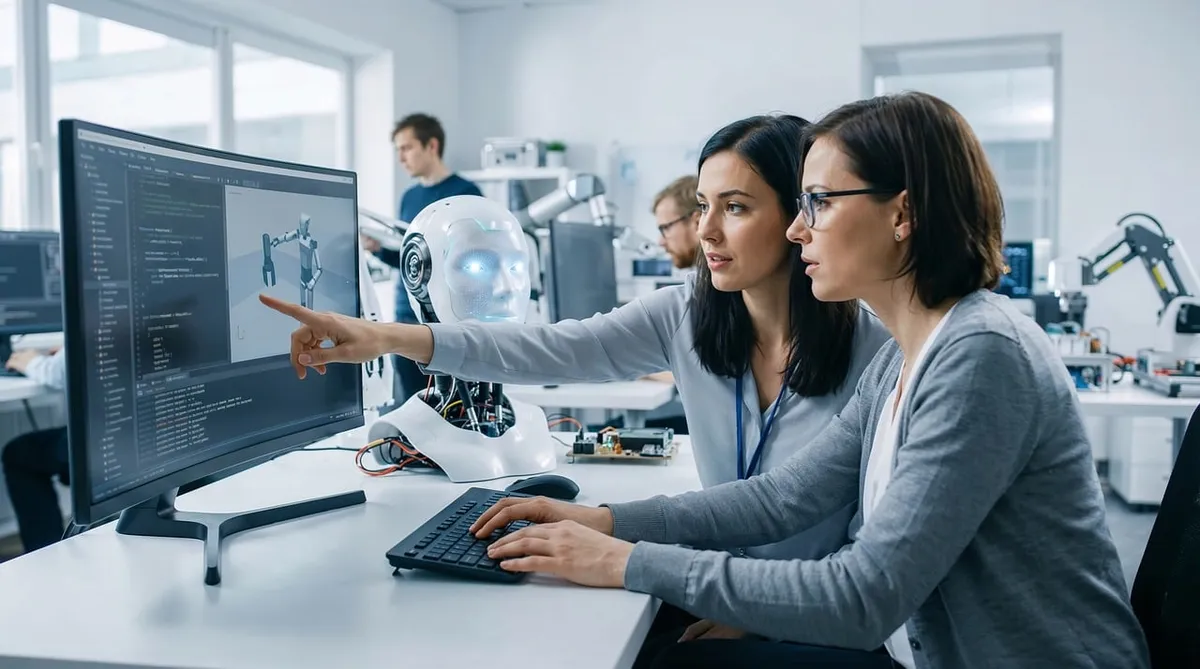
The landscape of medical tech research US is increasingly defined by the ability to translate digital insights into physical reality. Advanced sensors and automated liquid handlers work in tandem with AI to execute precise experiments.
This synergy minimizes human error and increases the reproducibility of results.
Modern breakthroughs often rely on the ability to process massive datasets, much like how the Organisation for Economic Co-operation and Development (OECD) noted that more than 60% of research and development in scientific and technical fields involves complex data management.
This high percentage of R&D involvement underscores the importance of digital literacy in the scientific community.
Researchers are now able to simulate complex biological environments, providing a more realistic testing ground for new drugs. This capability helps in understanding the subtle nuances of drug-target interactions.
How does AI in drug development handle biological complexity?
At dawn, a scientist leans forward in their chair to feel the hum of the processor as the screen maps the intricate path of a drug.
A scientist observes a 3D protein structure rotating on a tablet, checking for potential binding sites. The visualization of molecular geometry is a critical component of modern drug design.
Integrating AI in drug development requires managing the inherent unpredictability of biological systems. Algorithms must account for the way proteins fold and how small molecules interact within a living cell. This requires significant computational power and sophisticated mathematical models.

The goal is to move beyond simple hits to more robust, clinically relevant leads. By simulating various physiological conditions, researchers can better predict the efficacy and safety of a compound. This predictive capability is a cornerstone of the current technological leap.
The complexity of these biological interactions means that no single algorithm can solve every problem. Instead, a multi-layered approach involving different types of machine learning is often required.
Can we predict the future of pharma AI US?
An executive reviews a pipeline of digital drug candidates, weighing the probability of success for each. The strategic management of these pipelines is a key driver of investment in the sector.
The future of pharma AI US will likely involve an even tighter integration of generative models that can design entirely new molecules from scratch. These models do not just screen existing libraries but actively propose novel chemical structures.
This proactive approach could lead to entirely new classes of therapeutics.
The transition from discovery to clinical application remains the most significant hurdle. While AI can suggest a perfect molecule, it cannot yet fully replicate the complexities of a human body during a clinical trial.

Success in this field will depend on how well researchers can bridge the gap between digital prediction and biological reality. The industry is currently focused on validating these digital leads through increasingly sophisticated in vitro and in vivo models.
What are the limitations of current AI models?
A researcher runs a validation test, comparing the AI’s prediction against the actual laboratory result. Discrepancies between the digital and physical worlds are a constant reality in drug discovery.
One major limitation is the quality and diversity of the training data. If the input data is biased or incomplete, the AI will produce inaccurate or narrow results. This can lead to the selection of candidates that fail unexpectedly in clinical settings.
The ability to generalize findings across different populations is another significant challenge. A model trained on a specific dataset may not perform well when applied to a different demographic or disease subtype. This requires continuous refinement and the use of diverse biological datasets.
Furthermore, the biological systems are far more complex than current models can fully capture. While simulations are improving, they are still approximations of reality.
How to implement AI-driven workflows in a lab?
A team of scientists gathers around a large screen to review the latest simulation results. They are preparing to move from the digital phase to the physical testing phase.
To implement an AI-driven workflow, follow these steps:

- Establish a centralized data management system to ensure all experimental results are digitized and standardized. 2. Integrate specialized machine learning algorithms that are tailored to the specific biological targets of interest. - 3. Create a feedback loop where physical laboratory results are fed back into the AI to refine its predictive accuracy. 4. Perform a final check to ensure that the digital leads meet all safety and solubility criteria before proceeding to wet-lab testing.
I found that setting up a clear data pipeline was the most critical part of our initial transition to digital modeling. Without organized data, the most advanced algorithms remain ineffective.
A limitation is that the effectiveness of these models is inherently constrained by the quality of the biological data available for training.
- Integrate high-throughput data acquisition tools into existing hardware.
- Standardize data formats to ensure seamless ingestion into machine learning models.
- Establish automated feedback loops between computational predictions and wet lab validation.
Related







Comments 0